What's the Cost Difference Between Repairing and Replacing Ducts in Lake Mary?
Most Lake Mary duct calls start the same way. A homeowner hands us a high electric bill, points at the back bedroom that never cools down, and asks whether it's cheaper to fix the ducts or just replace them.
The honest answer sits between a few hundred dollars and several thousand. Which end of that range fits your home depends on what our techs actually find when they climb into your attic. Age of the ductwork matters a lot. So does the amount of damage, whether mold has gotten inside any runs, and how the existing insulation is holding up under Florida summer heat.
This page walks through what we charge for repair work in Lake Mary, what a full replacement tends to run, and how to tell which one actually fits your home. No pressure, no pitch, just the breakdown we'd give a neighbor.
TL;DR Quick Answers
Duct repair in a Lake Mary home usually costs a fraction of full replacement. Most repair jobs land in the low hundreds to low four figures, while full replacement typically runs from the mid-four-figure range for smaller homes into five figures for larger ones in Heathrow or Markham Woods.
When repair makes sense: ductwork under 15 years old, localized leaks, no mold.
When replacement is the right call: ductwork past 15 years in a Florida attic, mold across multiple runs, or existing ducts that fail current Florida Building Code.
The middle path most homeowners don't hear about: partial replacement of the worst runs paired with selective sealing on the rest — often most of the benefit of full replacement at closer to repair pricing.
Lake Mary's climate shortens ductwork service life compared to national averages, so a local technician's on-site read matters more than any online calculator.
Top Takeaways
Duct repair in Lake Mary typically costs a fraction of full replacement, and the exact savings depend on leak count, attic access, and what material is already installed.
Full replacement becomes the right call when ductwork passes 15 years old in a Florida attic, when mold shows up across multiple runs, or when the existing system fails current Florida Building Code.
ENERGY STAR reports that 20 to 30 percent of conditioned air is typically lost to duct leakage, which is why either repair or replacement usually pays for itself over time.
Lake Mary's climate shortens ductwork service life compared to national averages, so national cost calculators often understate what Florida homes actually need.
Partial replacement paired with selective sealing is often the best-value option for homes in the middle, and it should always be on the table during any duct inspection.
A free Filterbuy HVAC Solutions inspection in Lake Mary gets you the specific numbers for your home before any decision gets made.
Duct Repair Cost in Lake Mary
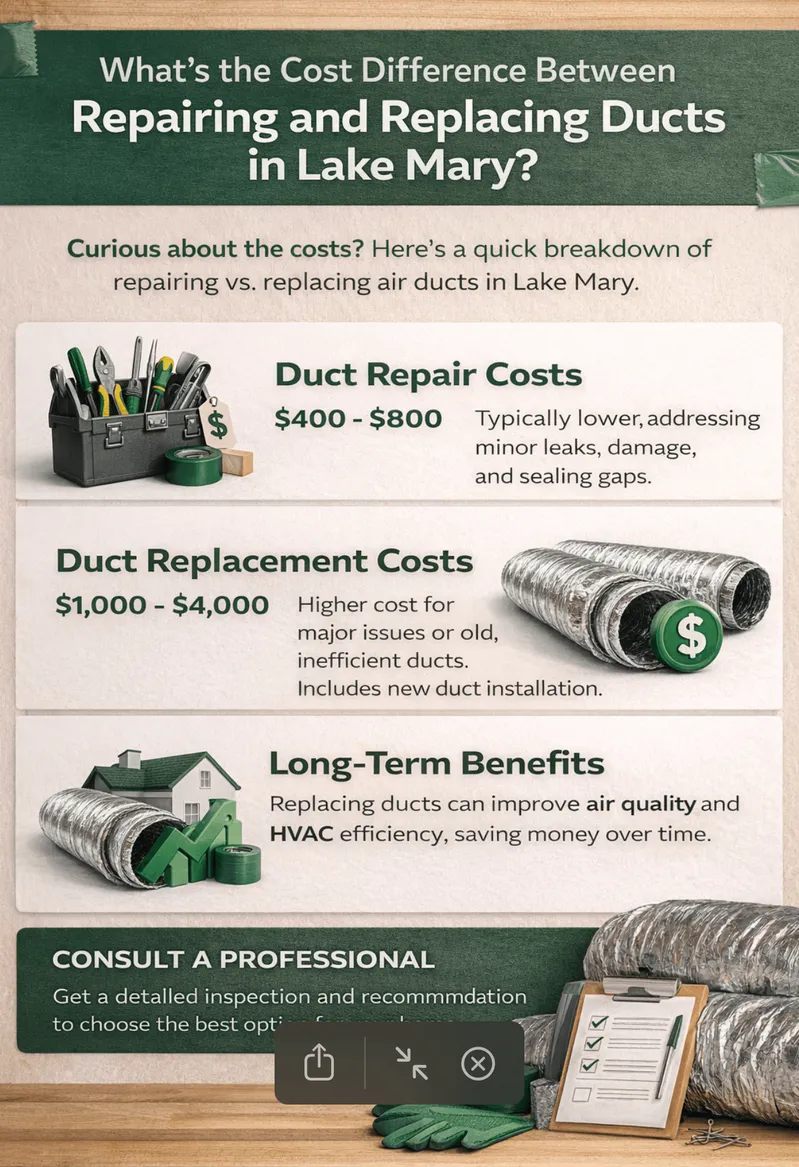
Duct repair in a typical Lake Mary home runs from the low hundreds for a single-leak hand-mastic seal up through the low four figures for a whole-system Aeroseal treatment. Which method we use depends on what we find during the inspection.
A hand-mastic seal is the right call for accessible leaks at boot connections, trunk line joints, or a pulled flex duct run. Aeroseal works better when leaks are scattered throughout the system and hard to reach, since it pressurizes the ductwork and carries sealant directly to every gap. Both methods stay well under the cost of tearing everything out and starting over.
What pushes the price up or down inside that range comes down to a few things we check during the inspection. The big one is attic access. A Lake Mary attic hitting 130 degrees in July slows every technician down and raises labor hours. Leak count drives the rest, since ten small gaps across the system eat more time than one obvious tear. What's already up there matters too. Sealing R-6 flex duct is a different job than sealing the older duct board we still find in homes from the 1990s.
Duct Replacement Cost in Lake Mary
Full duct replacement for a Lake Mary home typically lands between the mid-four-figure range for a smaller home and well into five figures for larger homes in Heathrow or Markham Woods. Labor usually takes one to three days depending on attic access and how much square footage we're replacing.
The replacement price covers removing and disposing of the old system, installing new flex or rigid metal duct sized for the current AC unit, bringing insulation up to current Florida code, sealing every connection, and running a post-install leakage test. That test isn't optional. Florida Building Code requires it, because an untested replacement can leak as badly as the ductwork it replaced.
A few situations push a job out of the repair column and into replacement. Ductwork that's pushed past 15 years in a Florida attic has usually run out of service life, especially if it's the flex duct most Lake Mary homes got installed in the early 2000s. Mold across multiple runs means sealing won't actually solve the problem. A new AC sized differently from the original often needs ducts resized to match. And when existing R-values fail current code, replacement brings the whole system up to spec in one move.
Side-by-Side Cost Comparison
Across the three home size categories we work in most often — under 1,500 square feet, 1,500 to 2,500 square feet, and over 2,500 square feet — the gap between repair and replacement holds the same general shape. Repair costs a fraction of replacement in every tier, and the savings actually get more favorable as square footage grows, because larger homes have more duct runs for leaks to spread across.
Across every home size we work on, repair costs a fraction of replacement on paper. The real work is figuring out whether the cheaper option actually fixes what's happening in your ducts, or whether it just delays the inevitable.
How to Decide: Repair, Replace, or Both
Five questions usually settle it once a technician has walked the system.
How old is the ductwork? Anything over 15 years in a Florida attic is near end-of-life, and repair dollars don't stretch as far on aged material.
What percentage of the system is damaged? Damage under roughly 30 percent of the system usually favors repair. Damage above that usually favors replacement.
Is mold or microbial growth present inside the ducts? Sealing over mold traps the problem behind the fix. Multiple runs with mold almost always mean replacement.
Is the AC unit itself due for replacement soon? Replacing ducts now and the AC in two years wastes the duct-sizing work. When the AC is close to end-of-life, it's usually worth bundling the two.
Does the ductwork meet current Florida Building Code? If the existing system fails current sealing or insulation standards, replacement brings it up to code in one move.
A partial replacement paired with selective sealing often handles the in-between cases. If one section of duct is visibly damaged and the rest passes inspection, we'll replace only the damaged runs and seal what's left. That keeps costs down without leaving a compromised system in the attic.
Why Lake Mary Changes the Math
Summer attic temps here run above 120 degrees for months at a time, which slowly cooks the outer jackets on flex duct and pulls old mastic loose from every joint it touches. Year-round humidity sitting above 70 percent keeps condensation forming inside the runs, and that's the starting condition for mold. On top of all that, every time the AC cycles on during storm season, leaky returns pull attic pollen and dust straight into the air the family breathes.
Home age plays into it too. A lot of the 1990s builds in Lake Mary came with return ducts sized a little tight for the AC, which means those systems have worked harder than they should have for thirty years running. Early 2000s construction leaned hard on flex duct, and most of that flex is now at or past what flex is built to last in a Florida attic. Custom builds in Heathrow, Timacuan, and Markham Woods usually run longer than spec-builder homes, which gives them more surface area to lose air through and more insulation sitting in the heat.
All of that changes the repair-versus-replace math in Lake Mary compared to a national average. A technician's on-site read matters more here than any online calculator.
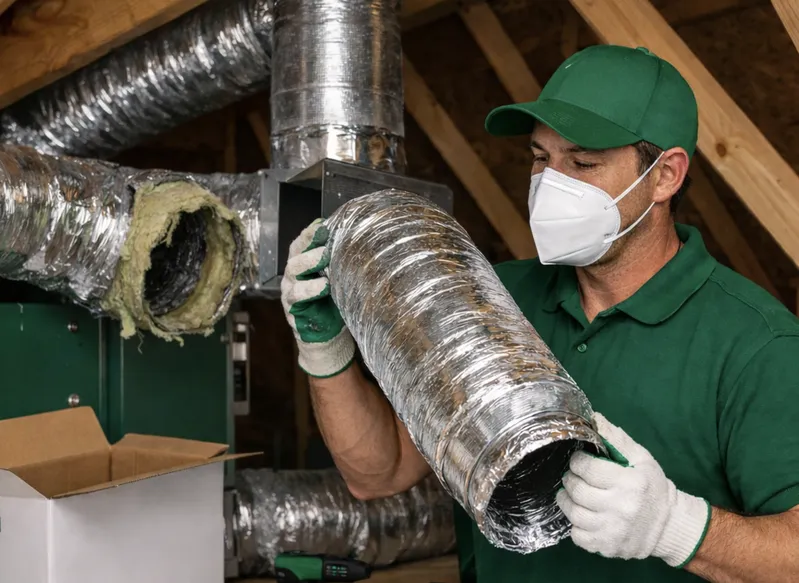
"I'd rather seal twelve leaks in a ten-year-old flex duct system than replace it for a family who doesn't need to spend that kind of money yet. But the moment we find mold inside the duct board or a sagging run up in a 131-degree attic, I'm telling that homeowner honestly that repair is the wrong answer. A lower price only matters if it actually solves the problem."
7 Essential Resources
Each link goes to a public .gov, .org, or .edu source a Lake Mary homeowner can cross-check on their own.
ENERGY STAR Duct Sealing
ENERGY STAR's duct sealing page breaks down what leaks actually cost and walks through sealing options. It's a straight read from the federal program that sets a lot of the guidance our techs follow in the field. https://www.energystar.gov/saveathome/heating-cooling/duct-sealing
U.S. Department of Energy: Minimizing Energy Losses in Ducts
The DOE write-up on duct losses goes deeper on why sealing pays back and why balanced return airflow matters as much as supply flow. Worth a read before any big decision.
https://www.energy.gov/energysaver/minimizing-energy-losses-ducts
EPA Indoor Air Quality
EPA's indoor air quality hub connects the dots between HVAC systems and what ends up in the air your family breathes. Useful context when leaky ducts are pulling attic dust and pollen into the house.
https://www.epa.gov/indoor-air-quality-iaq
UF/IFAS Extension, Energy Efficient Homes: The Duct System
University of Florida IFAS Extension put together a duct-leakage piece that speaks directly to Florida homes. The numbers line up with what we see every week in Lake Mary attics. https://ask.ifas.ufl.edu/publication/FY1024
CDC Mold in Homes
CDC's mold page covers the basics of mold, humidity control, and the conditions mold needs to grow, including inside ductwork. A good read when you're weighing whether sealing over a mold problem makes sense. https://www.cdc.gov/mold-health/about/index.html
OSHA Brief Guide to Mold
OSHA's guide to mold in buildings pulls identification, remediation, and the health side into one reference. Homeowners and contractors can both use it.
https://www.osha.gov/publications/shib101003
ASHRAE
ASHRAE is the engineering society behind most of the HVAC technical standards that show up in Florida Building Code. If you ever want to check whether a contractor is quoting something real, their site is where to look. https://www.ashrae.org
Supporting Statistics
The numbers worth knowing when you're weighing repair against replacement. Each one comes from a different federal or university source.
ENERGY STAR reports that roughly 20 to 30 percent of the air moving through a typical home's duct system gets lost through leaks, holes, and poorly connected joints. That loss is usually what's driving the high electric bill that raised the repair-versus-replace question in the first place. https://www.energystar.gov/saveathome/heating-cooling/duct-sealing
University of Florida IFAS Extension reports that typical duct systems lose 25 to 40 percent of the heating or cooling energy the HVAC system produces, and Florida's climate plus attic conditions push systems toward the higher end of that range. https://ask.ifas.ufl.edu/publication/FY1024
The U.S. Department of Energy notes that ducts leaking conditioned air into unconditioned spaces can add hundreds of dollars a year to heating and cooling bills. That's a big piece of why sealing and insulation usually pay for themselves over time.
https://www.energy.gov/energysaver/minimizing-energy-losses-ducts
Final Thoughts and Opinion
Here's what we've seen after years of working in Lake Mary attics. Most homeowners who ask the repair-or-replace question have already been told the wrong answer by somebody with a reason to push one option over the other. Contractors who only do replacements will tell you to replace. Contractors who only do sealing will tell you to seal. The right answer depends on what's actually in your attic right now, not on what somebody in your kitchen wants to sell you.
If the ductwork is under 15 years old and the damage is sitting in a few identifiable places, duct repair is almost always the better call for your wallet and your comfort. Sealing brings back most of the energy loss at a fraction of what replacement would cost. When the ductwork is pushing 20 years in a Florida attic or mold has worked its way across multiple runs, repair turns into good money chasing bad. Replacement costs more upfront, but it resets the clock and brings everything up to current code in one pass.
The middle path matters too, and it's the one homeowners rarely hear about in a sales pitch. Replacing the two worst runs and sealing the rest often gets you most of the benefit of a full replacement at something closer to repair pricing. The only way to know which path fits your home is to have a technician walk the system and actually measure what's happening.
Frequently Asked Questions
How much does it cost to repair ducts in a typical Lake Mary home?
Most Lake Mary duct repair jobs fall between a few hundred dollars for a single-leak hand-mastic seal and the low four figures for a whole-system Aeroseal treatment. The exact number depends on how many leaks our inspection finds, how accessible the attic is, and whether the existing ducts are flex, rigid metal, or older duct board.
How much does full duct replacement cost in Lake Mary?
Full replacement for a typical Lake Mary home runs from the mid-four-figure range for a smaller home up into five figures for larger homes in Heathrow or Markham Woods. The price covers removing and disposing of the old system, new duct sized for the current AC, insulation to current code, and the post-install leakage test required by Florida Building Code.
When is duct repair the better choice for Lake Mary homeowners?
Repair usually makes sense when the ductwork is still under 15 years old and the damage is limited to a few spots we can actually reach. The inside of the runs also needs to be clean, since sealing over mold just traps the problem behind the fix. When those pieces line up, sealing gets you most of the way back at a fraction of what replacement would cost.
When should a Lake Mary homeowner replace ducts instead of repairing them?
Full replacement is usually the right call once ductwork passes 15 years in a Florida attic, when mold and sagging flex duct show up across multiple runs, or when a new AC is going in at a different size than the original. Ducts that fail current Florida Building Code for sealing or insulation also need replacement, since there's no patching your way up to code on those.
Does homeowners insurance cover duct repair or replacement in Lake Mary?
Homeowners insurance typically doesn't cover ductwork wear or age-related failure, but it may cover sudden damage from a covered event, like a fallen tree through the attic or water damage from a covered leak. Review your specific policy with your insurer before assuming it will or won't pay for the work.
How long does duct repair or replacement take in a Lake Mary home?
A typical repair job takes a few hours to a full day depending on leak count and attic access. Full replacement usually runs one to three days depending on square footage and how difficult the existing ductwork is to pull out.
Can Lake Mary homeowners finance duct repair or replacement?
Yes. Filterbuy HVAC Solutions offers financing options so homeowners can get the work done now rather than wait through another Florida summer with high bills and uneven cooling. Our team walks through payment plans during the free inspection, so you'll see the numbers before any decision gets made.
Get a Real Look at Your Ducts
Deciding between repair and replacement usually gets clearer once a technician has actually climbed into the attic and measured what's happening. If you're in Lake Mary and want a straight answer about what your ductwork needs, we'll send somebody out for a free inspection with no pressure and no obligation attached. Our tech will walk your system and tell you honestly what we'd do if it were our own home.
Tap here to schedule your free Lake Mary duct inspection.
Or give the local line a call and ask for a same-week appointment. We live and work in Central Florida, and we're ready when you are.
Learn more about HVAC Care from one of our HVAC solutions branches…
Filterbuy HVAC Solutions - Miami FL - Air Conditioning Service
1300 S Miami Ave Apt 4806 Miami FL 33130
(305) 306-5027
https://maps.app.goo.gl/Ci1vrL596LhvXKU79